Monday, June 2, 2008

Canon EOS 450D (Rebel XSi)


Canon EOS 450D (Rebel XSi) a Digital Single-Lens Reflex camera from Canon is the best of Canon's addition to the world of Digital Photography. It has high sensitivity CMOS sensor, with effective resolution of 12.20 mega pixels and total 12.40 mega pixel. It can save images both in JPEG and 14-bit Canon RAW format. It features Canon's Digic-III image processor.

The maximum file size of a picture as provided on Canon's website are

Large/Fine : Approx. 4.3MB (4272 x 2848 pixels)
Large/Normal : Approx. 2.2MB (4272 x 2848 pixels)
Medium/Fine : Approx. 2.5MB (3088 x 2056 pixels)
Medium/Normal: Approx. 1.3MB (3088 x 2056 pixels)
Small/Fine : Approx. 1.6MB (2256 x 1504 pixels)
Small/Normal : Approx. 0.8MB (2256 x 1504 pixels)

RAW : Approx. 15.3 MB (4272 x 2848 pixels)

Though actual sizes may vary,depending on settings used.

Canon EOS 450D has following support:
White Balance: Auto, Daylight, Shade, Cloudy, Tungsten, White Fluorescent Light, Flash, Custom
Shutter Speeds: 1/4000 sec. to 30 sec
Self-Timer: 10-sec or 2-sec delay or 10-sec delay with continuous shooting
Remote Control: Remote Controller RC-1/RC-5
Continuous Shooting Speed: 3.5 shots/sec
Power Saving: Automatic power turn off after 30 sec, 1, 2, 4, 8, or 15 min
Back-up Battery: Built-in secondary battery

All this at MRP $799.99 for only the camera body. You will need to pay seperately for the lens.

Sunday, June 1, 2008

Hybrid Hard Drive

Hybrid Hard Drive (HHD) is a combination of the Hard Disk Drive (HDD) with a large amount of non-volatile flash memory (called as buffer memory). Its just like a Hybrid Car that can run on both batteries as well as fossil fuel as and when required for greater efficiency.

The flash memory in a HHD starts at a minimum of 128 MB. HHD with 256 MB buffer capacity have been developed. A prototype of HHD with 1GB buffer has also been developed. The buffer memory of HDD ranges between 2 - 16 GB. HDD with 32 MB buffer have been developed though.

Hybrid Hard Drive definitely offers better performance and lower power consumption as compared to any other HDD. Because they make use of Flash memory the data that is frequently used is stored in the Flash memory of the HHD. This reduces the time required to fetch data from the particular area of the disk. Also as Flash memory has no moving parts, the possibility of reducing the life of your hard drive due to long uses is greatly reduced.

Hard Drive usage apart from reducing power consumption, increasing life of your hard disk, reduce also the boot-up time your computer, by caching the data required by computer for next boot-up. The most significant increase in speed will be while resuming from hibernation mode. The data to resume from from hibernation mode will be stored into the buffer memory of HHD, and due to high speed of Flash Memory, it will be loaded very fast in the RAM. The difference of resuming from 'Standby' and 'Hibernation' mode may vanish, thereby making Operating System manufacturers completely do away with standby mode, and use only hibernation mode.

From the point of view of prices, Hybrid Hard Disk is definitely going to cost more than the Hard Disk Drive of same capacity. But thinking of all the advantages they offer over HDD, they are definitely worth it. Also Solid State Drive, which are much superior than either of these are very expensive. Using a Hybrid Hard Drive, will definitely be a much greener alternative to the Hard Disk Drive.

Sunday, May 4, 2008

Intel Atom Processor

Intel has developed a new processor 'Atom', with very low power requirements in the sub 3 watt range, and also while supporting a highest frequency of up to 1.86GHz. Manufactured using the new hafnium-infused 45nm high-k silicon technology, Intel Atom processors pack an astounding 47 million transistors on a single chip measuring less than 25mm², making them Intel's smallest and lowest power processors. This processor has been mainly focussed towards latest Mobile Internet Devices.

Some features of the Atom Processor are:
  • Single-core processor for mobile devices offering enhanced performance

  • On die, primary 32-kB instructions cache and 24-kB write-back data cache

  • Hyper-Threading Technology 2-threads

  • On die 512-kB, 8-way L2 cache

  • Intel® Virtualization Technology (Intel® VT)

  • Thermal management support

  • Intel® Deep Power-Down Technology

  • L2 Dynamic Cache Sizing

  • Advanced power management features including Enhanced Intel SpeedStep® Technology

The technologies used by Intel for Atom Processor are:


High Performance Technology
  • Intel® Hyper-Threading Technology: Provides performance & support for multi threaded applications enabling increased performance and system responsiveness in multitasking environments by enabling the processor to execute two instruction threads in parallel.

  • Intel® Virtualization Technology: It is a set of hardware enhancements on the Intel® Atom processor series providing the flexibility to run dual operating systems and applications in independent partitions.

  • Intel® Digital Media Boost: Enhanced Performance on Floating Point intensive applications such as CAD tools, 3D & 2D modeling, Video Editing, Digital Music, Digital Photography & Gaming

  • Intel® Smart Cache: Smarter, more efficient cache & bus design thus offering even more efficient data sharing, providing enhanced performance, responsiveness and power savings.

  • Power Optimized Front Side Bus: 533MHz FSB provides increased data bandwidth as compared to prior generations (400MHz) for faster data transfer.

  • Enhanced Data Prefetcher: Efficient speculation and loading into L2 cache of data likely to be requested by processor.

Low Power Capabilities

  • Enhanced Intel® SpeedStep® Technology: Allows for better match of performance to application demand.

  • Deep Power Down Technology with Dynamic Cache Sizing: Dynamic Cache Sizing saves power by turning off Cache ways that have had data saved in memory. This power saving feature enables 80-100mW idle power and 160-220mW average power for the processor.

  • Low Thermal Design Power: Lower thermal design power enables thinner, lighter MID devices as it reduces the cooling requirements.

  • Mobile Voltage Positioning: Dynamically lowers voltage based on processor activity to lower thermal design power.

  • Enhanced Deeper Sleep: Saves power by flushing cache data to system memory during periods of inactivity to lower CPU

Ultra Small Form Factor CPU Package


The new lead free, halogen free Micro-Flip Chip package (13x14mm) is 85% smaller than a notebook processor (35x35mm)


The Power requirement for the Atom Processor are


Power Requirement
(W)
Lower FrequencyHigher Frequency
0.65 W600MHz0.8GHz
2 W600MHz1.1GHz
2 W800MHz1.33GHz
2 W800MHz1.6GHz
2.4 W800MHz
1.86GHz

Friday, January 18, 2008

Changing Text on XP 'start' Menu

Bored of the XP start menu???? Change this to 'your_name' menu by just a few easy steps as follows:

1.1)Download 'Resource Hacker' from http://delphi.icm.edu.pl/ftp/tools/ResHack.zip.


1.2)Make a backup copy of C:\WINDOWS\explorer.exe on your desktop.
1.3)Extract and open 'Resource Hacker'.
1.4)Open C:\WINDOWS\explorer.exe in 'Resource Hacker'


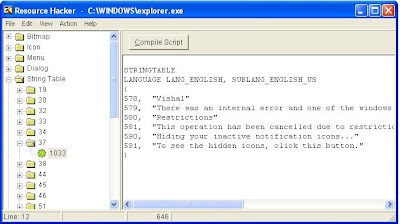
1.5)Navigate to String Table -> 37 -> 1033 in the left pane of 'Resource Hacker'


1.6) In Right pane on line no 578 select the start text and rename it with your name along with the double quotes. 'Vishal' in this case. Click on 'Compile Script' and then save the file as 'vishalexplorer.exe' in C:\WINDOWS\ directory


2.0)REGISTRY EDITING:

WARNING: PLEASE DONT MODIFY ANY REGISTRY SETTINGS OTHER THAN THIS AS IT CAN MAKE YOUR PC UNUSABLE.


2.1) Open Run from Start menu Start -> Run. Type regedit.exe in run dialog box and press Ok.


2.2) In 'Registry Editor' in left pane Navigate to HKEY_LOCAL_MACHINE\SOFTWARE\Microsoft\WindowsNT\CurrentVersion\Winlogon


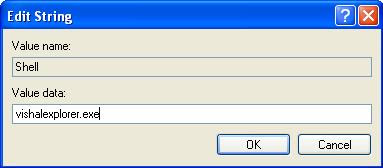
2.3) Click on Winlogon and in right pane search for " Shell "having Data 'explorer.exe'.
Modify it to 'vishalexplorer.exe'.


2.4) Close Registry Editor.

3.0) Restart your computer. And the result is:

Monday, January 14, 2008

Nano

The all new Tata Nano is set to beat the best engineering minds, a task thought impossible to accomplish. But Ratan Tata was not moved by comments made by others.

The car features an all-aluminum, 0.62 litre engine that runs on petrol. The engine is designed for maximized smoothness and fuel efficiency, and comes fitted with an advanced electronic management system and balance shafts to help meet this goal.

The car looks cool as than many other comparing it's price factor. Mileage expected is about 20 km in city. So that's the real thing the Indian middle-class people are looking for good mileage, terrific looks, and yes a affordable price of Rs.1 lakh. The real price in market is expected to be about 1.3 lakh considering taxes. It is hoped that Tata will launch a diesel version soon.

As far as my opinion is concerned, Tata's should have considered making an electric car. Using gasoline or petrol will add to already increasing pollution by green house gases. Making an electric car will also help in reducing the operating cost of the vehicle.

Finally, it will be great to see this car in the Indian market. People all over the world are exited about this car. Seems that the world not only India is waiting for the launch of this cool baby!

Technology & Computers